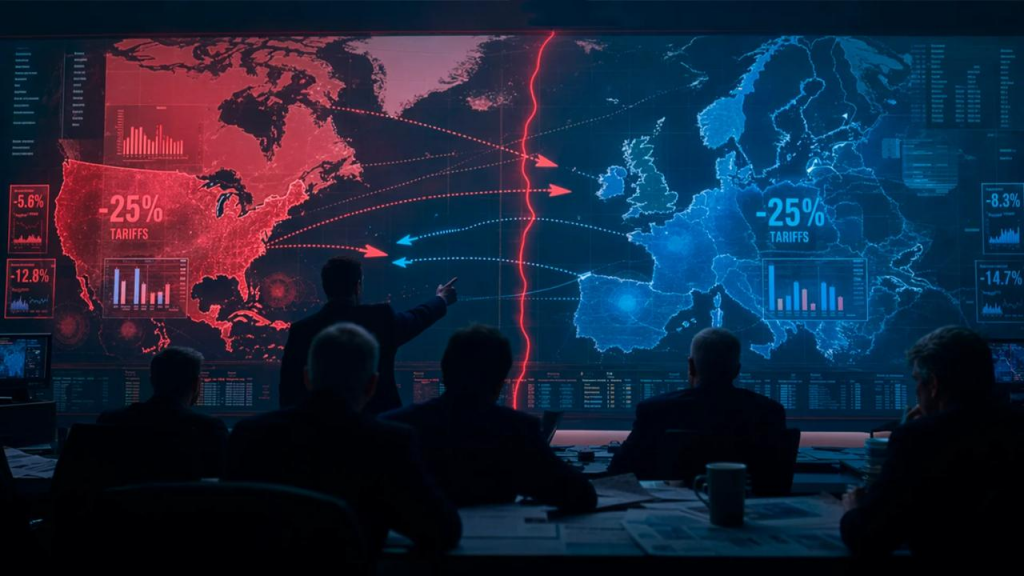
Trade relations between the United States and Europe are entering a more complex phase, as tariffs and industrial policy move back to the center of economic strategy. What was once seen as a temporary tool is now becoming part of a broader shift toward protection, resilience, and geopolitical positioning.
While tensions have not escalated into a full-scale trade war, the direction of policy on both sides suggests that tariffs are likely to remain a defining feature of transatlantic relations in the coming years.
📊 The Current Situation
In recent years, the United States has increasingly relied on tariffs and trade measures to support domestic industries and reduce dependence on foreign supply chains.
Key sectors affected include:
- steel and aluminum
- automotive manufacturing
- clean energy technologies
- advanced industrial goods
Europe, as one of the U.S.’s largest trading partners, is directly impacted by these measures. While some tariffs are longstanding, others have been introduced or adjusted as part of broader economic and political strategies.
At the same time, the European Union has taken a more cautious approach, focusing on negotiation, regulatory alignment, and internal market strength rather than immediate escalation.
⚡ Why Tariffs Are Becoming Strategic
Tariffs are no longer just about trade balances.
They are increasingly used to:
- protect strategic industries
- encourage domestic production
- influence global supply chains
- respond to geopolitical risks
This reflects a shift away from pure globalization toward what analysts describe as “economic security” or “strategic autonomy.”
Both the U.S. and the EU are investing heavily in domestic capacity, particularly in sectors like:
- semiconductors
- renewable energy
- critical raw materials
Tariffs, in this context, act as a supporting mechanism.
🌍 Europe’s Position
The European Union faces a delicate balancing act.
On one hand, it seeks to:
- maintain strong trade ties with the United States
- avoid escalation that could harm exports
On the other hand, it must:
- protect its own industries
- respond to competitive pressures
- ensure fair market conditions
Policies such as industrial subsidies, regulatory frameworks, and trade agreements are being used alongside tariffs to achieve these goals.
💶 Economic Impact
The effects of tariffs are gradual but significant.
For businesses:
- higher costs of exporting goods
- pressure on profit margins
- need to adjust supply chains
For consumers:
- potential price increases
- shifts in product availability
For markets:
- changes in capital flows
- sector-specific volatility
While these impacts may not be immediately visible, they accumulate over time.
🔍 Signs of a Structural Shift
One of the most important developments is the move toward regionalization of trade.
Instead of a fully global system, the world is gradually dividing into:
- regional economic blocs
- controlled supply networks
- strategic partnerships
This does not mean the end of globalization — but it does suggest a more selective and structured version of it.
❓ What to Expect Next
Looking ahead, several scenarios are possible:
1. Controlled Competition
The U.S. and EU continue to use tariffs selectively while maintaining overall cooperation.
👉 Most likely scenario
2. Gradual Escalation
More sectors become subject to tariffs, increasing pressure on industries.
👉 Medium risk
3. Policy Alignment
Negotiations lead to partial alignment and reduced tensions in key sectors.
👉 Less likely but possible
⚠️ Key Risks
- expansion of tariffs into new industries
- retaliatory measures
- disruption of supply chains
- increased uncertainty for investors
🔥 Conclusion
Tariffs between the United States and Europe are no longer isolated policy decisions.
They are part of a broader transformation in how economies operate, compete, and protect themselves in an increasingly uncertain world.
Rather than a sudden conflict, what we are seeing is a slow but steady shift in the rules of global trade.
👉 Final Thought
The most important changes often happen quietly.
And in the case of tariffs, the impact is not always immediate —
but it is already shaping the future of transatlantic economic relations.